
Moderation Won’t Save Democrats
The pull of partisanship has left the vast majority of states out of reach for both parties.

If you are a free subscriber and you like what you’re reading, maybe it’s time to upgrade to a paid subscription.
This newsletter is 100% reader-supported, and your subscription helps me continue publishing.
Truth and Consequences is a reader-supported publication. To receive new posts and support my work, consider becoming a free or paid subscriber.
When you become a paid subscriber, you receive access to all my posts, the ability to comment on posts and engage in the Truth and Consequences community, and, above all, you get the warm and fuzzy feeling that comes with supporting independent journalism.
House Cleaning
You might have noticed that Brian and I are off this week. Both of us are very busy, but we are also discussing what we want to do with “Two Bearded Jews” and possibly turning it into a standalone podcast. So keep your eyes out for that.
Also, I’ve been a bit busy since my last post.
Over the weekend, I wrote for MSNOW about rising anti-Semitism in the UK and why it offers a terrifying preview for American Jews. And I got personal with this one, so please check it out.
Next, as Southern states continued their onslaught against Black political representation in the deep South, I wrote about how the Supreme Court is no longer even pretending to act in a non-partisan manner — and if Democrats have any hope of holding political power and enacting their policy agenda, they need to make Court packing a top legislative priority — and a litmus test for Democratic presidential candidates.
The courts’ increasingly partisan lean puts Democrats in a near-impossible situation. Even if Democrats control the House, Senate and White House come January 2029 — still a reasonable possibility — there’s every reason to believe that the court’s conservative majority will use its judicial veto to undermine Democrats’ political and legislative objectives.
This is why an increasing number of Democratic politicians and pundits are calling on the party, if it takes back power, to pack the court with liberal judges in order to undo the conservative majority’s political stranglehold. And they are right to do so.
But what has so far been a trickle could soon become a torrent. A political environment where the nation’s highest court is the GOP’s political trump card is not one in which Democrats can engage in normal politics. They will be operating on a playing field that, because of the court’s interventions, will be tilted toward Republicans.
If a law as sacrosanct as the Voting Rights Act is vulnerable from the Supreme Court’s meddling, no legislation passed by Democrats will be safe. Adding new justices is a more-than-reasonable response to a Supreme Court that continually acts with thinly veiled partisan zeal.
There Ain’t No Gold In Them Thar Hills

Along these lines, there was a familiar pundit response to the Virginia Supreme Court’s decision last week striking down the state’s redistricting referendum: Democrats need to moderate their policy views and adopt heterodox positions to win in places where, up to now, they have consistently lost.
In Bulwark, Lauren Egan took on the question of Southern politics and asked several Southern Democratic operatives, “How do Democrats compete for House seats in this region when the districts have been drawn by Republicans to overwhelmingly favor their own side?”
Their answers are the same ones we’ve been hearing for 2-3 decades, as Democrats have consistently lost election after election in the South.
It starts with the candidates they recruit to run. Operatives repeatedly told me that the party needs to embrace people with political views on issues—whether it be guns, immigration, or various social and cultural topics—that fall substantially outside the boundaries of the national Democratic mainstream. They stressed that this will mean ditching purity tests and elevating people who aren’t hyperpartisan or highly ideological. And, they said, this shift can’t just happen at the state level: It will require buy-in from the national party at large
“We have to build a broader coalition in all these places, and we have to create space for candidates like John Bel Edwards,” said Steve Schale, a Democratic operative who has worked on races across the Southeast, referring to Louisiana’s former governor. “That’s going to be a huge test for the national party—whether we are willing to not only create the space for those candidates within the coalition, but also create the space in our rhetoric, in our branding as a larger party, to give those people a chance to win.”
I like Steve Schale, and he seems like a really nice guy. But what do people think Democrats in the South have been doing? Democrats are not running DSA candidates in these states. When it comes to John Bel Edwards, the former two-term Democratic governor of Louisiana, his very political prominence suggests that Democrats are creating space for candidates who stray from mainstream Democratic policy views. Edwards opposed abortion rights. Did national Democrats complain when he ran for office? Not really. They were just happy that a Democrat won a statewide race in ruby red Louisiana.
But here’s the other thing about Edwards. A large part of why he initially won his election race is that his opponent, Senator David Vitter, was ensnared in the DC Madam scandal. If Vitter were a normal Republican candidate who hadn’t been caught sleeping with prostitutes, it’s highly unlikely that Edwards would have won the governor’s mansion in 2015.
As Jacob Rubashkin pointed out on Twitter, in 2019, Edwards “won reelection by 3% but only managed to carry 1 of Louisiana’s 6 districts — majority Black CD2. He only came close in 1 other; the rest he lost by double digits.” Edwards won a second term because he’d been a reasonably successful governor, and partisanship is often less of an issue in gubernatorial elections than in federal races. But his experience was a fluke, and it’s not easily replicable.
Let’s consider another son of the South — former Arkansas senator Mark Pryor. In 2008, he ran unopposed for reelection. Pryor was hardly a dyed-in-the-wool liberal. Indeed, he regularly voted against gun control measures in the Senate and famously earned an A grade from the NRA. Did that help him when he ran for reelection in 2014? No, he lost by 17 points to Republican Tom Cotton. And to add insult to injury, the NRA gave Cotton millions in campaign dollars to take down Pryor.
When given a choice between a Republican and a Democrat who strays from Democratic policy orthodoxy, Arkansas voters choose the real thing. The problem for Democrats is that, in many states, voters prefer Republicans, which is why there is not a single Democratic senator in a state that Trump won in each of the last three elections.
To give you a sense of how daunting it would be for Democrats to win in the Deep South, here’s a list of Trump’s margins of victory in Southern states in 2024:
Alabama - 30 points
Arkansas - 30.6 points
Kentucky - 24.5 points
Louisiana - 22 points
Mississippi - 22 points
South Carolina - 17.8 points
Tennessee - 29.7 points
The two exceptions are Georgia (2.2) and North Carolina (3.3), which is why Democrats are favored to hold the Georgia Senate seat and potentially pick one up in North Carolina.
But in these other states, a Democratic Senate candidate would have to outperform Kamala Harris by at least 18 points. That. Is. Not. Happening.
The bottom line is that even the most heterodox Democrat cannot outrun the increasingly sharp partisan polarization of national politics.
Even if one used 2020 as a baseline, the best Biden performance in the Deep South that year was in South Carolina, which he lost by 11.7. But keep in mind that no Democrat has won a statewide election in South Carolina since 2006.
One reason Texas seems like a place where Democrats could flip a Senate seat from red to blue is that Biden lost the state by 5.5 points in 2020 (Harris lost there by nearly 14 points in 2024). But Democrats’ chances are significantly higher if Republicans pick scandal-ridden Ken Paxton in this month’s run-off election. For Democrats to win in red states, the GOP nominee has to be either hopelessly corrupt (Paxton), morally suspect (Roy Moore in Alabama, Vitter), or deeply unpopular (Matt Bevin in Kentucky).
To be sure, this is not just a Democratic problem. Republican Senate candidates can’t win in blue states either. Today, there is one Republican senator in a state that Democrats won in the last three elections — Susan Collins in Maine.
In fact, Senate GOP candidates struggle mightily in any state that is not ruby red. For example, in the six swing states that flip-flopped between 2016 and 2024 (AZ, NV, WI, MI, PA, GA), there are 12 senators. Ten of them are Democrats - that’s 85 percent. Four of the six governors are Democrats - that’s 65%. In the next-closest state, North Carolina, which Trump has won three times, there’s a Democratic governor and two Republican senators. However, Democrat Roy Cooper is narrowly favored to flip one of those seats this year.
But Republicans pay less of a price for their inability to win outside of red states because there are more red states than blue ones. If not for the Senate’s rural state lean, which heavily favors Republicans, Democrats would likely be in the majority.
So does that mean Democrats should give up on trying to win in red states? I suppose it can’t hurt to try, but they should be realistic about their chances.
This year, there are a handful of states where Democrats have a) recruited strong candidates, b) the Republican candidate is particularly weak, and c) the larger political environment heavily favors Democrats. That gives Democrats a chance in places like Texas, Alaska, Iowa, and Ohio. But don’t forget, these states all voted for Trump by double-digits in 2024 (though in 2020 the margins were all below 10, except Alaska, which Trump won by nearly 11 points). Democrats will need their candidates to outperform their 2020 baseline and by a significant margin to win. Don’t be surprised if it doesn’t happen.
Instead, Democrats should do everything they can to win in places where the GOP presidential victory was narrow (North Carolina), where they won in 2020 (Wisconsin), and where they’ve won in the last three presidential elections (Maine). Maybe they get lucky somewhere else (Alaska, Iowa, Ohio, or Texas) — and guess what, they’d have a majority in the Senate and a chance to actually accomplish something (like adding Supreme Court seats).
But winning in red states where Trump has consistently won by double digits. That simply ain’t happening.
What’s Going On
Democrats got a reprieve on the GOP’s redistricting efforts. Mississippi canceled plans to redraw its maps this year, the South Carolina Senate rejected a redistricting plan, and Alabama and Louisiana, which could have theoretically drafted maps that flipped four seats, now appear poised to flip only two. And we are still waiting to see what happens in Florida when the state Supreme Court rules on a new map that clearly violates the state’s constitution.
South Carolina Governor Henry McMaster might call a special session to try to ram a new map through.
Maryland Democrats are now debating rewriting their maps before the November election — which would likely eliminate the state’s lone GOP district. However, it’s a long shot.
Still, 3-4 fewer seats flipping from blue to red makes it that much more likely that Democrats win the House in November (and it was already pretty likely).
Credit card delinquencies are at their highest point since 2011 … the Great Recession. Inflation hit 3.8% in April, outpacing wage growth. Yesterday, Trump said, “I don't think about Americans' financial situation, I don't think about anybody." Gonna be a rough Election Night for Republicans in November.
“I’m Dying Here”
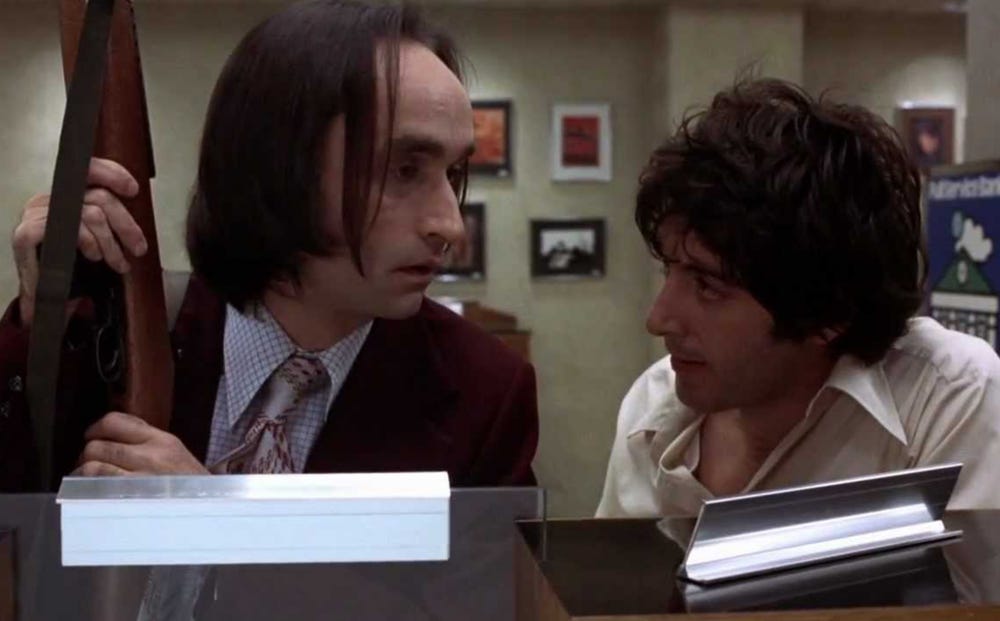
This week on That ‘70s Movie Podcast, Jonathan and I wave the white flag for the 1975 classic “Dog Day Afternoon.”
This movie is 70s, New York filmmaking at its absolute peak. Phenomenal acting performances from Al Pacino, John Cazale, Charles Durning, and Chris Sarandon, inspired direction from the underappreciated master Sidney Lumet, Dede Allen’s brilliantly paced editing, a razor-sharp screenplay by Frank Pierson, and wonderful cinematography from Victor Kemper. It doesn’t get much better than this stone-cold classic.
So grab your guns, book your flight to Wyoming, and step out on the sidewalk for the latest episode of “That ‘70s Movie Podcast.”
Check it out on Apple Podcasts and Spotify.
Musical Interlude
Imagine a Republican asks you: how do we compete in New England? We hold no Congressional districts (though I expect ME-2 to flip). What would your advice be? Well, I think my advice would be to cater to the voters. Try to moderate in some spots, rally your voters around some wedge issues, and then do a good job in office. Maybe that would work.
I don't know. Maybe like Charlie Baker in Massachusetts. Or Phil Scott in Vermont. Or Susan Collins in Maine. You get the point. What Steve and others are asking you and Democrats to do is exactly what Republicans have done in places to win.