
The Democratic Establishment Keeps Winning
Tuesday night was yet another reminder that Democratic voters are quite pragmatic

If you are a free subscriber and you like what you’re reading, maybe it’s time to upgrade to a paid subscription.
This newsletter is 100% reader-supported, and your subscription helps me continue publishing.
Truth and Consequences is a reader-supported publication. To receive new posts and support my work, consider becoming a free or paid subscriber.
When you become a paid subscriber, you receive access to all my posts, the ability to comment on posts and engage in the Truth and Consequences community, and, above all, you get the warm and fuzzy feeling that comes with supporting independent journalism.
Earlier today, Brian Rosenwald and I talked about last night’s primary results for the latest episode of “Two Bearded Jews Talk Politics.”
You can check out the whole episode here, and while you’re at it, subscribe to the podcast so you’ll get alerts when we post new episodes and leave a comment!
You can also check out our last episode with Elliott Morris, now in podcast form!

But first, a quick recap: it was another good night for the establishment wing of the Democratic Party.
The left got one big win in New Jersey, as Adam Hamawy prevailed in a crowded field to replace Bonnie Watson Coleman, who is retiring. New Jersey’s 12th district is a solid blue seat, so Hamawy is a good bet to win in November, even with recent allegations about his relationship with Sheik Omar Abdel Rahman, a militant Islamist, who is in federal prison for his participation in the 1993 bombing of the World Trade Center.
But this was not exactly the most impressive victory — Hamawy received just 28 percent of the vote.
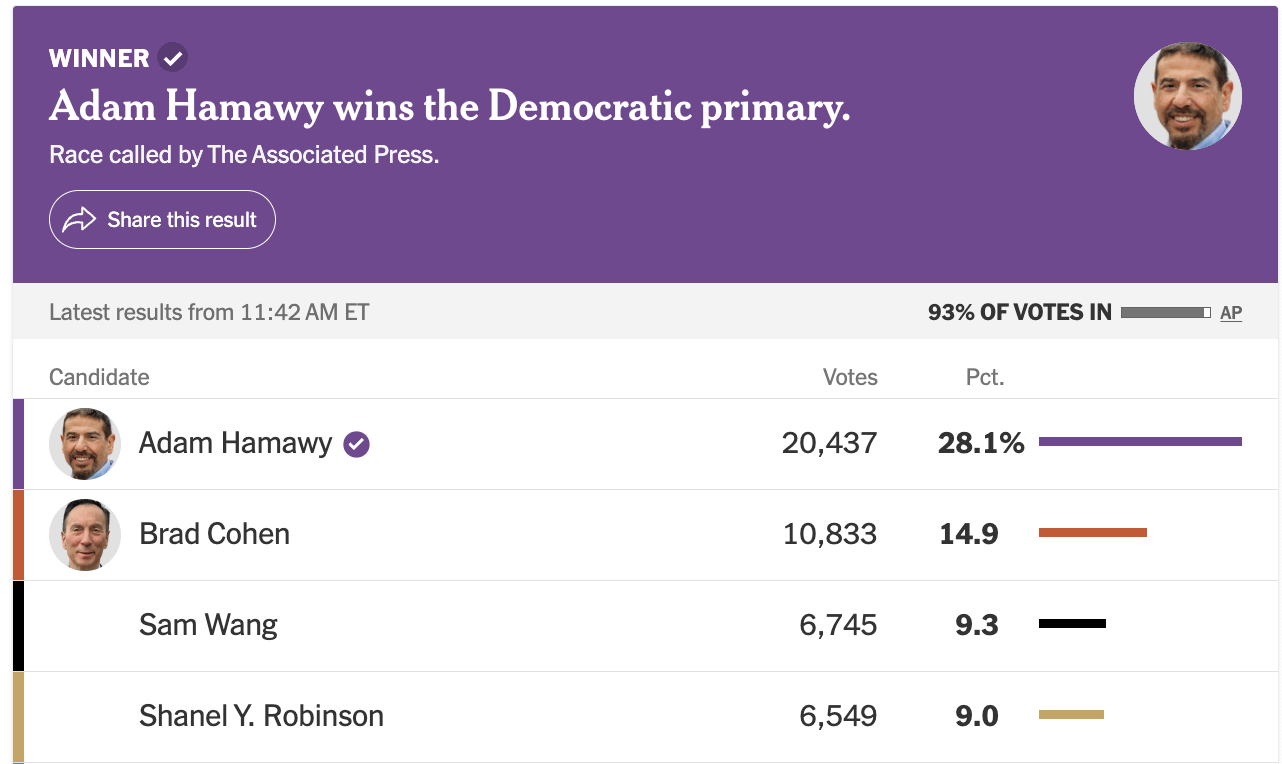
This outcome was similar to what happened in a February special election in NJ-11 in which fellow DSA member Analilia Mejia beat a crowded field … with 29% of the vote (facing token opposition, Mejia easily won her primary on Tuesday). Yes, DSA folks are winning races, but they are benefiting from crowded primary fields in heavily blue districts (another DSA candidate, Chris Rabb, won a House primary in Philadelphia last month with 45% of the vote).
But in more competitive head-to-head races, left-wing candidates fared worse. In Iowa, the left rallied around Iowa State Senator Zach Wahls in his race against Josh Turek, also a state legislator. Turek received tacit support from Democratic insiders, and he crushed Wahls: 63-37.
He’ll face off against Rep. Ashley Hinson to fill the seat vacated by Joni Ernst, who is retiring. Turek has a chance here. Iowa has been hit hard by Trump’s tariffs; the president is uniquely popular, and Turek, a Paralympic gold medalist, has the kind of political makeup that could win in a red state. Turek will likely get a boost from his ticket-mate, Rob Sand, who won the Democratic nomination for governor. Sand, who already looked like a good bet to flip the governor’s mansion from red to blue, got some help from Republicans. The frontrunner for the GOP nomination, Rep. Randy Feenstra, whom President Trump endorsed, was upset by Zach Lahn, a Republican entrepreneur who has never held political office. Sand has been polling quite well against Feenstra, but taking on a political novice could significantly help his chances.
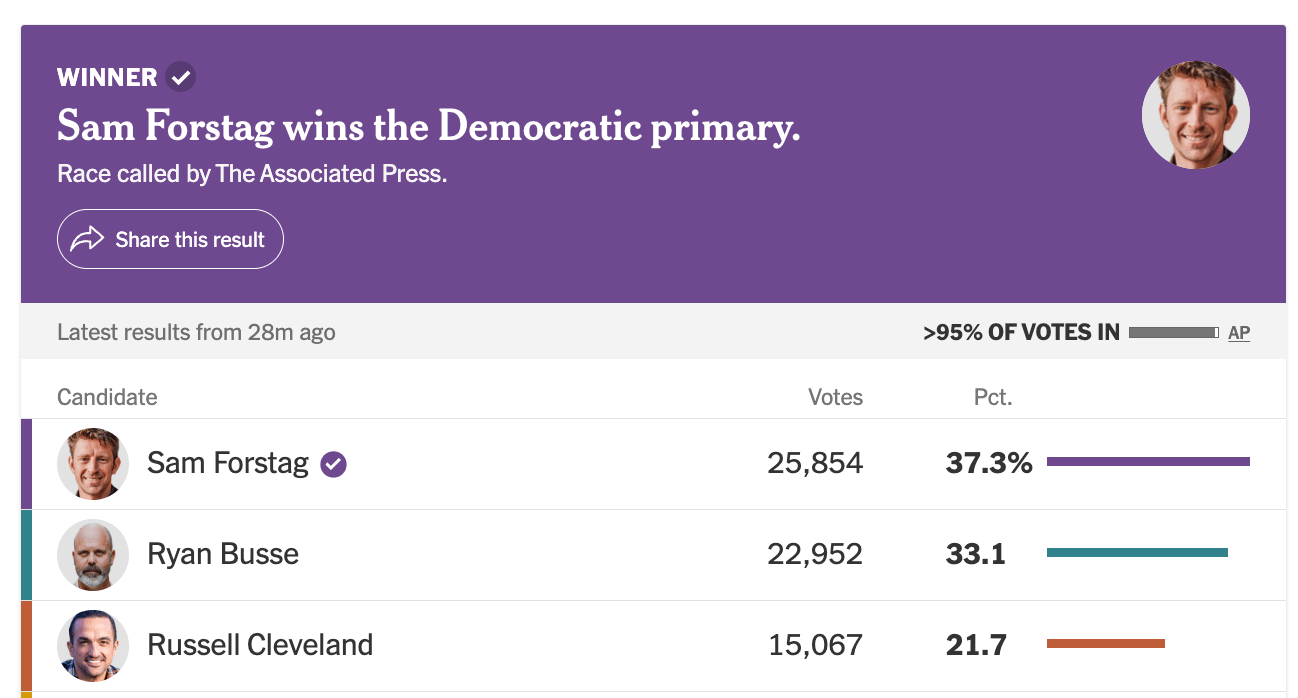
In Montana, the left can claim a victory: Sam Forstag won the Democratic primary in MT-1 after a late campaign rally from AOC. However, again, Forstag only got 37% of the vote.
In California, as usual, it is taking forever to count the votes. In the governor’s race, Republican Steve Hilton is currently leading over former establishment favorite, HHS Secretary Democrat Xavier Becerra, with fellow Democrat, billionaire Tom Steyer in third place. Steyer received significant support from the left, and there’s still a chance he can pass Hilton and make it an all Democratic race in November. But right now he’s on the outside looking in.
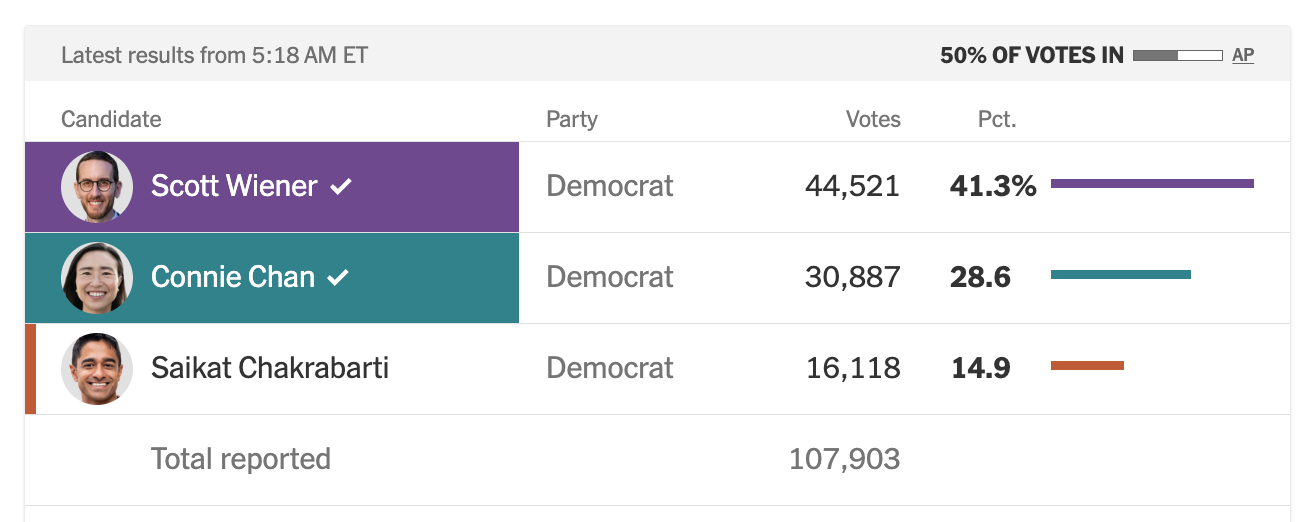
Down ballot, left-wing candidates again fared poorly. In Nancy Pelosi’s old district (she’s retiring), Saikat Chakrabarti, who is a former chief of staff to Alexandria Ocasio-Cortez, and held a campaign rally with Hasan Piker, got a paltry 15% of the vote. Even in the bluest of blue districts, voters weren’t buying what the left is selling.
Another perennial left-wing candidate, Ammar Campa-Najjar, lost in the 48th House district.
Randy Villegas, who Bernie Sanders endorsed, is slightly ahead of Jasmeet Bains by around 4 points in the 22nd district. The two Democrats are competing to challenge David Valadao, who is arguably one of the most vulnerable GOP incumbents in the country. Villegas is likely benefiting from the district’s large Hispanic population (CA-22 is 73% Hispanic). However, there are so many outstanding ballots in this district it’s a bit too soon to say if Villegas will prevail.
But if we widen the aperture, it’s clear that the anti-establishment insurgency just isn’t happening within the Democratic Party. Democratic Majority Leader Chuck Schumer’s preferred Senate candidates are doing well — for example, Roy Cooper in North Carolina, Sherrod Brown in Ohio, and Mary Peltola in Alaska. None of these candidates even got a primary challenge. Cooper and Peltola have led in practically every public poll, and a new poll out this week in Ohio has Brown up 8 points. In Texas and Iowa, the establishment favorites prevailed over their more liberal opponents.
Of course, there is the Maine exception, where Graham Platner’s meteoric rise pushed Governor Janet Mills out of the race. But, considering Platner’s abundant political baggage, Mills likely would have been the safer pick. If anything, Platner’s candidacy is a good example of why Democrats should avoid first-time, left-of-center candidates.
We’re still waiting to see what happens in Michigan, but in recent days, establishment favorite Haley Stevens has seen some good polling results, while Mallory McMorrow’s numbers are getting much worse. If McMorrow drops out of the race before the primary in August, Stevens will be well-positioned to defeat insurgent candidate Abdul El-Sayed.
So to make a long story short: Democratic voters are choosing pragmatism over ideology. Outside of very blue districts, the anti-establishment insurgency simply isn’t happening.
Musical Interlude