
The Iranian Clusterf**k
The US cease fire deal with Iran is a disaster and a strategic calamity. Let us count the ways.

If you are a free subscriber and you like what you’re reading, maybe it’s time to upgrade to a paid subscription.
This newsletter is 100% reader-supported, and your subscription helps me continue publishing.
Truth and Consequences is a reader-supported publication. To receive new posts and support my work, consider becoming a free or paid subscriber.
When you become a paid subscriber, you receive access to all my posts, the ability to comment on posts and engage in the Truth and Consequences community, and, above all, you get the warm and fuzzy feeling that comes with supporting independent journalism.
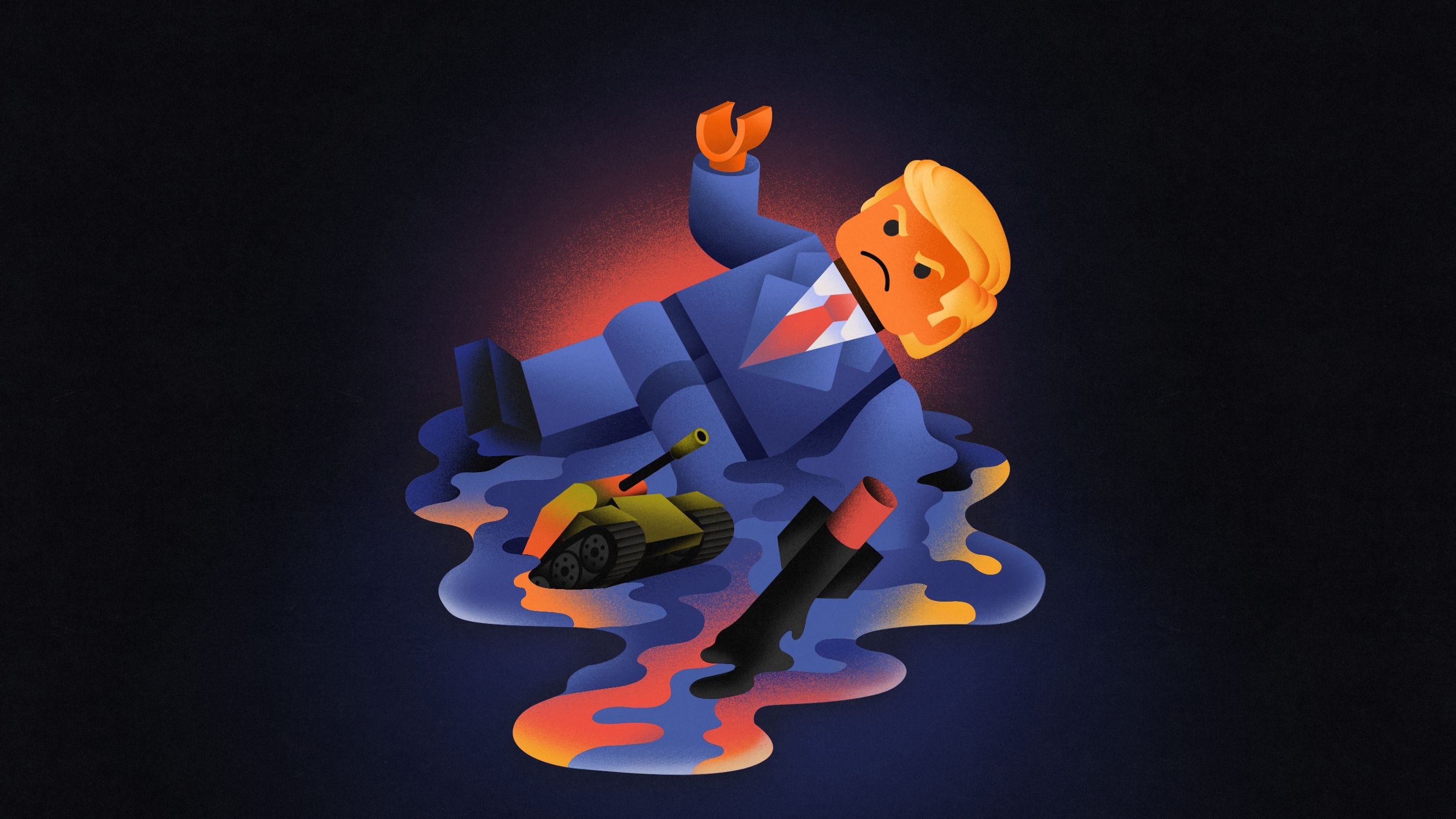
In all the years I’ve spent writing about foreign policy and war, I don’t think I’ve ever seen an end to a conflict met with as much uniform and universal condemnation as the US war with Iran.
To be sure, it’s not all that surprising. The White House agreed to a ceasefire extension or Memorandum of Understanding (MOU) that satisfied none of its prewar objectives, focused on an objective (opening the Straits of Hormuz to maritime traffic) that only arose because of the war itself, and provides enormous financial concessions to Tehran.
What is most interesting about the unending condemnation is that it’s coming from both sides of the political aisle. Democrats are making some variation of the argument “I told you so” or “leaving the Iran nuclear deal was a really, really bad idea.” Republicans are apoplectic that Trump signed such a terrible deal that gave so much away to the Iranians.
Indeed, as I wrote about in my latest column for MSNOW, the White House spin on the deal is utterly incoherent and speaks to the impossibility of polishing this turd.
Here is a copy of the talking points put out by the White House earlier this week.
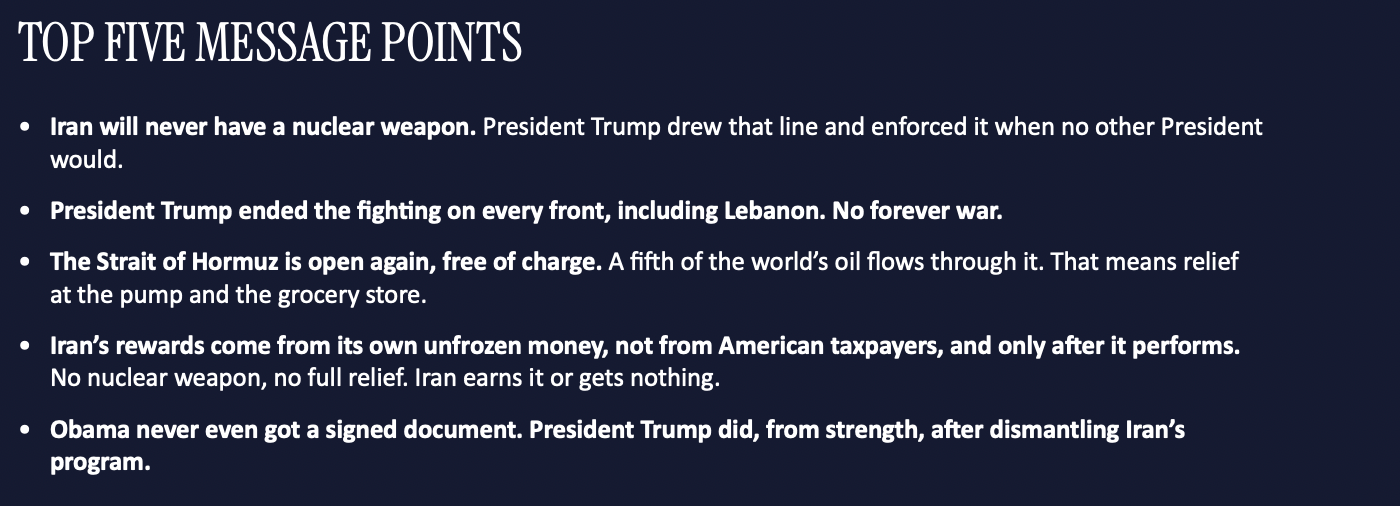
Let’s tackle these one by one.
“Iran will never have a nuclear weapon. President Trump drew that line and enforced it when no other president would.”
This language is purely aspirational, lacking any indication of how the US will ensure that Iran will not have nuclear weapons. There is every reason to believe that Iran will simply try to kick the can down the road in future negotiations, secure in the knowledge that the closer we get to the midterm elections, the less likely it is that Trump would countenance a renewal of fighting. Beyond that, Iran now understands it has enormous strategic leverage due to its ability to close the Persian Gulf.
Moreover, let’s compare the sentence above with a sentence from the first paragraph of the Joint Comprehensive Plan of Action, or JCPOA, signed by the Obama administration and Iran in July 2015: “Iran reaffirms that under no circumstances will Iran ever seek, develop or acquire any nuclear weapon.”
So all Trump has done is get Iran to reiterate the same position it agreed to 11 years ago. However, the key difference between that agreement and the MOU is that the JCPOA included a host of verification and enforcement provisions, which Iran was adhering to before Trump pulled the US out of the deal in 2018. While the MOU allows for negotiations between the two countries on the nuclear issue, the US now has far less strategic leverage.
“President Trump ended the fighting on every front, including Lebanon.”
This claim is like an arsonist boasting that he put out the fire that he started. Trump STARTED the war.
Moreover, one of the White House’s stated rationales for the war was to end Tehran’s support for terrorist proxies like Hezbollah. Yet, in its desperation to reach a deal, the US pressured Israel to stop its attacks on Hezbollah. In fact, the MOU calls for “immediate and permanent termination of military operations on all fronts, including in Lebanon.” This outcome is yet another win for Iran and is a disaster for Israel, which is now confronting an emboldened Iran and a Hezbollah force that is far from defeated.
“The Strait of Hormuz is open again, free of charge.”
Fun fact: before the war began, the Strait of Hormuz was open and free of charge. This agreement reaffirms the prewar status quo. If anything, the war has demonstrated to Iran that shutting off maritime traffic in the Persian Gulf is an easy and highly effective way to hold the global economy hostage.
Indeed, one of Trump’s most stunning statements in a rambling, incoherent press conference at the G-7 summit in France was that he made the deal with Iran because “I didn’t want to see an economic catastrophe; if you kept this going, it could have happened.”
What he’s basically saying here is that he signed a terrible deal because Iran held the US and the global economy hostage. Think about the message this sends to Iran, or perhaps to China, about the power of economic leverage over Trump. Generally speaking, you don’t want to tell potential adversaries about the key pressure points that will push you to make concessions. Yesterday, Trump did just that.
“Iran’s rewards come from its own frozen money, not from taxpayers, and only after it performs.”
Unfreezing money for Iran is a reward for the regime, and a direct result of the war that the US initiated. And according to the MOU, the US and “regional partners” are committing to the creation of “a definitive, mutually agreed plan with at least $300 billion for the reconstruction and economic development of the Islamic Republic of Iran.”
I’m skeptical that this $300 billion aid proposal will ever come to fruition, but suffice it to say, this is a far bigger carrot than anything the US has offered Iran before. And to be clear, this aid appears to be contingent on progress on the nuclear issue, not ceasing Iran’s missile production, support for regional proxies, or even democratic reforms and an end to political repression. In short, Iran could potentially get billions of dollars in aid while maintaining its role as a source of regional instability and maintaining its tyrannical rule.
“Obama never even got a signed document. President Trump did, from strength, after dismantling Iran’s program.”
Ahem …
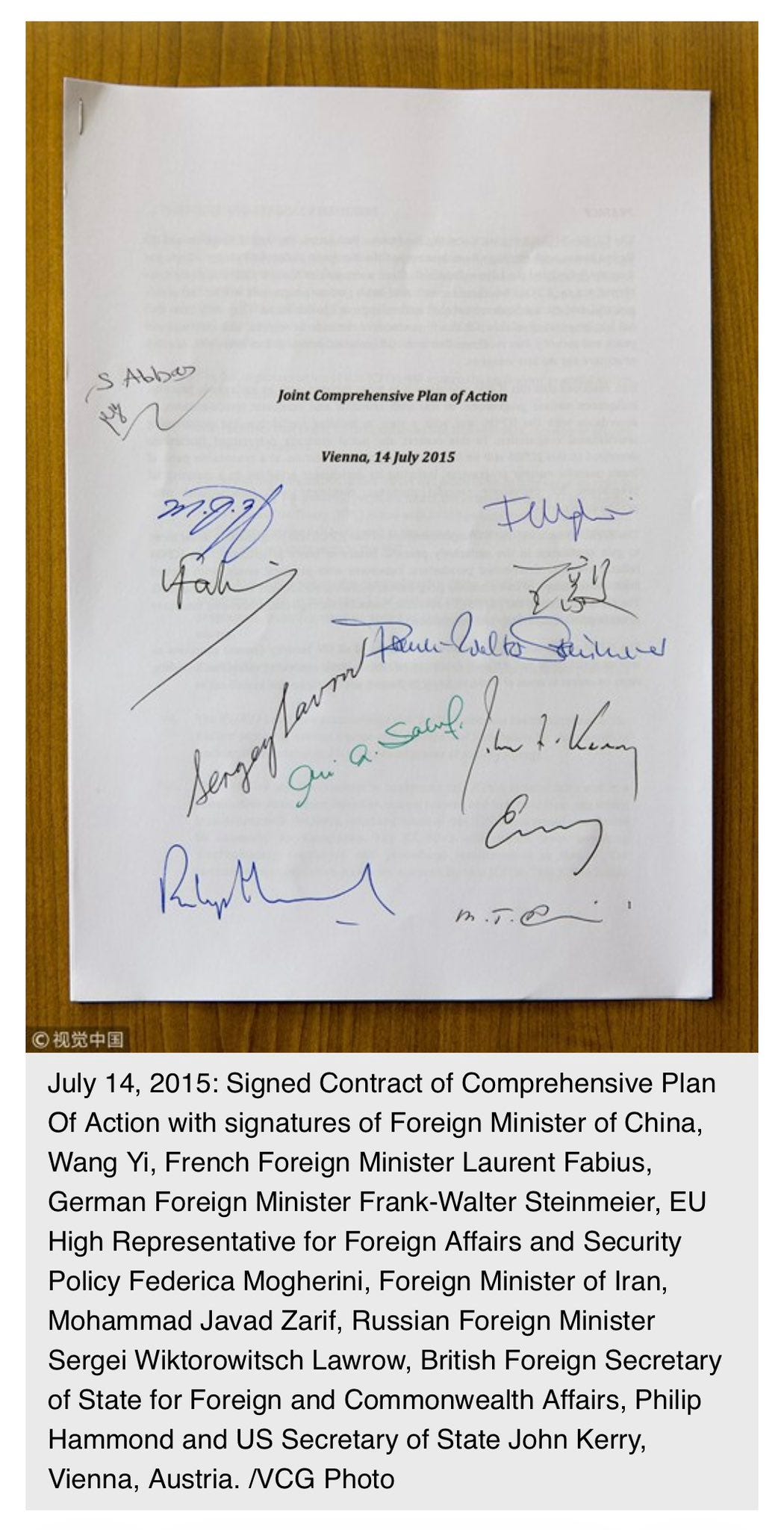
Also notice what’s not in the MOU. When Trump announced US military strikes on Iran, he said two of the key goals were :
“Destroy [Iran’s] missiles and raze their missile industry to the ground.”
“Ensure that [Iran’s] terrorist proxies can no longer destabilize the region or the world and attack our forces.”
There is no mention of either in the MOU. Indeed, at a press conference on Wednesday, Trump said, “Missiles aren’t the problem. Missiles, they hurt a little location, but they don’t blow up the planet.” Again, four months ago he said Iran continues “developing long-range missiles that can now threaten our very good friends and allies in Europe, our troops stationed overseas and could soon reach the American homeland.”
Most Americans no longer take anything Trump says seriously, but when the rest of the world thinks nothing the president says matters, that’s a recipe not just for American decline but also for global instability.
What’s Going On
Loved this piece by the Atlantic’s Matt Viser on Trump’s reflecting pool disaster.
Interesting Crystal Ball piece on why 2026 bears enormous similarities to the 2006 GOP bloodbath.
This piece provides a good annotated look at the MOU.
Musical Interlude
Iran likely looks to two countries, Ukraine and North Korea. One surrendered its nuclear weapons based on assurances, and is in a battle for its very existence, and the other told the world to pound sand, and it's treated much more carefully. If Iran is to give up its nuclear ambitions, they're going to expect a very, very sweet deal.
That's been the problem for 47 years, and it remains so. Short of a full-scale commitment of ground troops (and maybe not even then), Iran holds an awfully strong hand. The JCPOA was imperfect, because there's no perfect deal to be made with an adversary willing to pull the pin. Presidents and foreign policy experts have long recognized this. Trump didn't.
The upshot is that Iran now controls the world's most expensive tollbooth, and they're certain, and correct, that their threshold for pain is much higher than that of the United States. They're going to leverage both of those things. If, tomorrow, Iran informed the United States that they didn't wish to move forward with the MOU, what would be the most likely outcome? Further capitulation, because if one thing is certain, it's that the U.S. wants to wash its hands of the mess it got itself into, never to return.